Identity Theft’s Newest Attack Surface Is Time
By Uyo 5 min read
I once read about a young woman who came back to Nigeria after some time away and was picked up by the police. Kidnappers had been using her phone number to communicate.
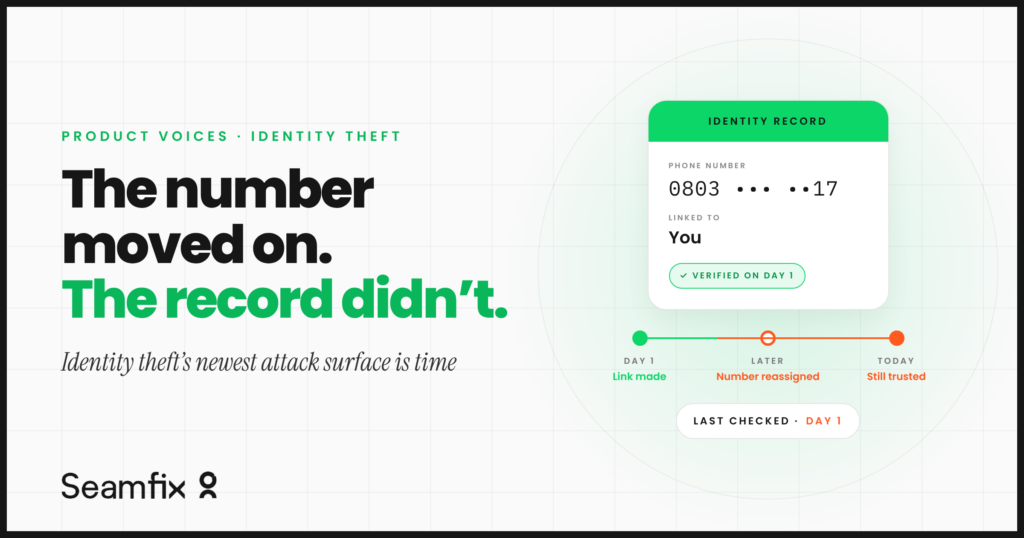
Except it wasn’t really her number anymore. She had stopped using it while she was out of the country, and it had been sold to someone else. The line moved on. The record still pointed to her.
We usually think of identity theft as something being taken from us: a card, a password, a face. Nobody took anything from her. She let go of something, and the world kept treating it as hers.
Your identity isn’t only what you carry. It’s everything you’ve ever left your name on.
The newest attack surface in identity theft is time. Identity systems link a person to a phone number, a document, an account or a face, then keep trusting that link long after it stops being true. Recycled numbers, SIM swaps and forgotten ID copies turn stale records into openings for fraud, and stronger locks don’t fix stale.
Identity theft’s attack surface has grown
Security teams call this the attack surface: every point where a system can be broken into. Apply it to a person instead of a network, and the map looks very different. The more doors and windows, the bigger the surface.
For most of us, the attack surface of our identity used to be small and physical. A wallet. Some cards. A set of keys. Keep them close and you were mostly fine.
That isn’t true anymore. Your identity now lives in dozens of places you don’t control, and some you’ve forgotten exist. The woman in that story wasn’t careless. She was exposed by something she had stopped thinking about.
The phone number became the master key
Start with the phone number.
It was never meant to be an identity. It was a way to reach you. Then, slowly, everything got attached to it. Your bank sends one-time passwords (OTPs) to it. Your email recovery runs through it. Your messaging apps are built on it. In many countries it’s tied to your national ID at registration: in Nigeria, that means the National Identification Number (NIN). Nobody decided it, but the phone number became the master key.
And you don’t own it. You rent it. Stop using it for long enough and the telco can give it to someone else. Whoever holds it next inherits whatever was still tied to it: the codes, the recovery links, and in her case, the suspicion. It’s like a new tenant moving into your old flat while your bank keeps posting your statements there.
Fraudsters don’t always wait for a number to be recycled. In a SIM (Subscriber Identity Module) swap, they convince or bribe someone at a telco to move your number onto a new SIM. From that moment, your bank’s security codes go to them. Nothing was hacked. The system did exactly what it was told. It works like match-fixing: you don’t beat the defence, you pay the referee.
The ID copies you forgot about
Then there are the copies.
Think about how many times you’ve handed over your ID. Hotel check-ins. Building receptions. A landlord who wanted a photo of it on WhatsApp. An agent registering you for a SIM or an account. Each of those transactions ended. The copy didn’t. It’s sitting in a folder, a phone gallery or a shared drive, and it will outlast your memory of handing it over.
The same goes for the records companies keep. Every bank, telco, lender and app that has verified you holds some version of you. Your identity is only as safe as the least careful of them, and you’ll never know which one that is.
When a face can be copied
Now your face is on the list too. It used to be the hardest thing to steal, because it was attached to you. Today one clear photo can be turned into a moving, blinking video. A leaked password can be changed. A face can’t.
The newest attack surface is time
These look like four separate risks. They share one cause. The newest attack surface in identity theft isn’t any one of these things. It’s time.
Every identity system works by linking a person to something: a number, a document, an account, a face. The link is true on the day it’s made. Then life happens. Numbers get recycled. Phones get lost. People move abroad, change names, pass away. The link quietly stops being true, and the system keeps trusting it.
That’s what happened to her. There was no forgery. A record that was once correct was still being treated as correct long after the truth had moved on.
It’s also why I think we’ve been framing identity theft wrong. We treat it as a theft problem, so most of the effort goes into locks: stronger passwords, better encryption, more checks at the front door. Those matter. But a lot of the damage now comes from stale links, and locks don’t fix stale.
Four questions for banks and telcos
If you run security at a bank, a telco or any service that relies on identity, ask your team four questions.
- When did you last confirm that this phone number still belongs to this person? Many telcos can now tell a bank when a number last moved to a new SIM, or whether it has been reassigned. A code sent to a number that changed hands last week proves very little.
- Is the phone number acting as proof of identity, or just as a way to reach someone? Those are different jobs, and most systems quietly let one do the other.
- When your system flags someone, what does it check before acting? “This number was used in a crime” and “this person committed a crime” are two separate claims. The space between them is where innocent people get picked up.
- How long do you keep copies of identity documents, and why? Every copy you hold past its purpose adds to someone else’s attack surface.
What individuals can do
For individuals, two habits help. When you stop using a number, tell your bank and update the accounts tied to it. Before you hand over a copy of your ID, ask why it’s needed and what happens to it afterwards.
She did what millions of people do. She left, stopped using a number and got on with her life. The system didn’t move with her.
That gap, between who a record says you are and who you are today, is the attack surface most of us never think to protect, and closing it starts with one habit: before trusting a link, check that it is still true today.