Dismissed for Fraud, Rehired by a Rival: How to Fix Field Agent Vetting
By Ademola Koledoye 6 min read
Dismissed for Fraud, Rehired by a Rival: How to Fix Field Agent Vetting
A fraudulent agent dismissed by one network can work for a rival a week later. Here’s how one biometric token and regulator oversight close that gap.
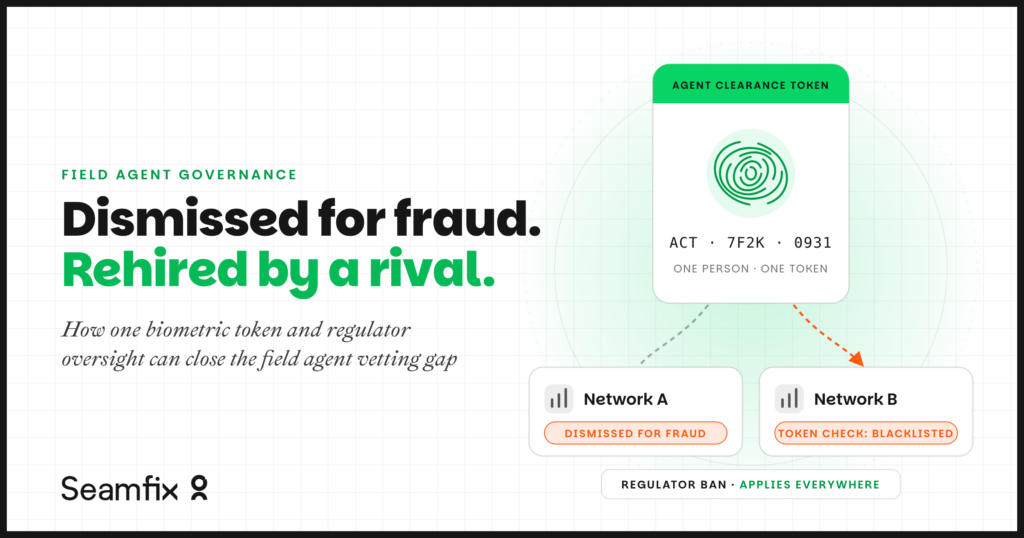
Imagine a field agent is dismissed by one mobile network for fraud. A week later, the same person is registering customers for a rival network. No rule was broken. The decision simply never reached the other network.
Why does this keep happening? Who should have the power to stop it? And how can it be done without competitors having to share their private information?
In short: regulators can govern field agents across multiple networks by giving each agent one clearance token tied to their biometrics, making the regulator the only party that can approve a ban, and running every case through the same evidence-based process that can be appealed. Networks check the token before taking on an agent and see only “active” or “blacklisted”, so a ban applies everywhere without competitors sharing personal data.
These are the questions we faced when designing the Agent Governance Platform (AGP), a system that lets regulators govern field agents across many networks and service providers. It rests on three things: one key for each agent, a neutral authority, the regulator, that has the final say, and a fair process that can stand up to challenge. The same idea works wherever an agent can serve several companies, such as agent banking, insurance sales and utilities.
Why Field Agent Governance Stops at the Network Edge
Field agents often work for several networks and distributors at the same time. Regulators hold each network responsible for its agents, but each network can only see the agents it hired itself. That leaves three gaps.
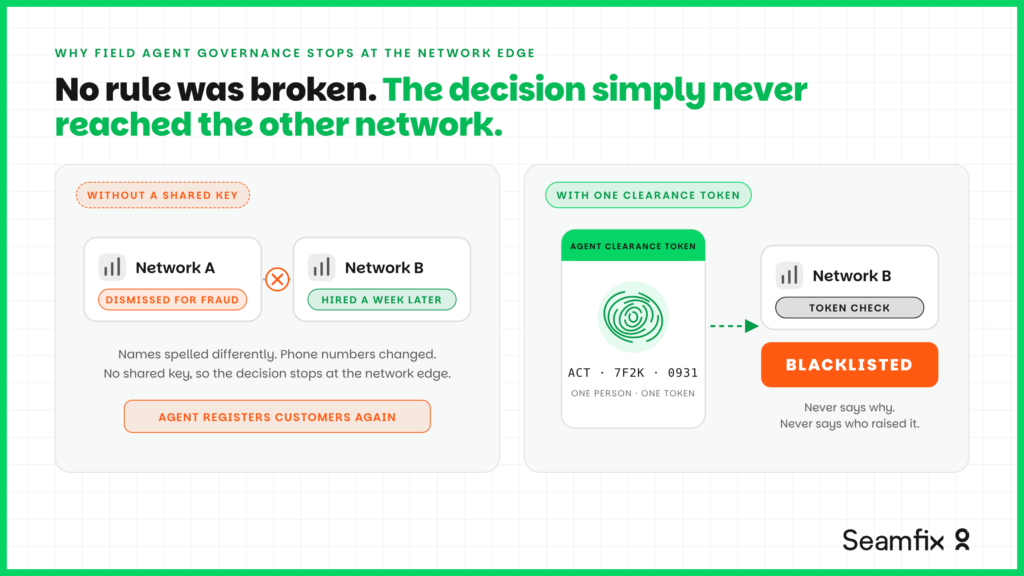
First, there is no common way to recognise an agent. Names are spelled differently and phone numbers change, so matching them fails. Passing lists of names between competitors also raises privacy and legal worries.
Second, there is no one everybody trusts to decide. A network has little reason to accept a rival’s claim that an agent is dishonest.
Third, the regulator only sees the big picture. It can penalise a network afterwards, but it cannot say today, “this person must not work for anyone.”
What is needed is a safe way to recognise the same agent everywhere, and a decision-maker nobody can accuse of acting for commercial gain.
One Key for Each Agent: The Agent Clearance Token
The fix is to give every agent one Agent Clearance Token, a unique identifier that works like a personal reference number. It is issued once, never reused and never given to anyone else. Before a network takes on an agent, it checks the token. The answer is only “active” or “blacklisted”. It never explains why, and never says who raised the concern. It works like an airline checking a no-fly list: the gate agent learns whether you can board, never why.
The token is tied to the agent’s biometrics, such as their face or fingerprints. That means one real person can hold only one token, and cannot get a second one by using a different name. In the movies, a new name and a new passport can get a villainous crew past security. A fingerprint doesn’t change with the passport. The token stands for the person, not for a phone number or an account.
This is what lets the regulator trace everything back to a human being. Every registration, every decision and every record carries the token, and the token points to one verified agent. At every point, the regulator can see which specific person was involved.
What Each Party Can See
Not everyone sees the same thing. A network sees only its own agents, plus a number showing how many other networks the agent works for, but not which ones. Only the regulator sees the full picture. The token is what travels between networks, not the agent’s personal details.
Who Should Decide That an Agent Is Barred?
We looked at three ways to decide.
- Each network decides alone. This is quick, but no other network has to follow it.
- The networks decide together. Everyone follows it, but competitors end up judging each other.
- A neutral authority, such as the regulator, decides. This is slower, but every network can accept it and it applies everywhere.
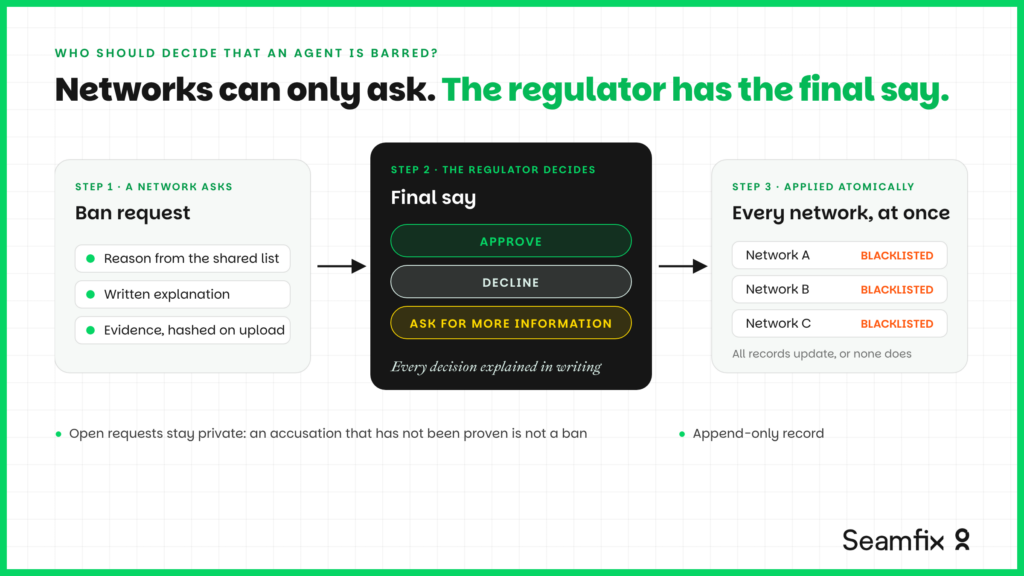
We chose the third. The regulator has the final say, and networks can only ask. A ban pushed by one company against a rival’s agent could be challenged in court, and no company would join a system where a competitor could remove its people. Think of how football handles discipline: when FIFA (the Fédération Internationale de Football Association) bans a player, the ban holds in every league, not just at the club that reported him.
How a Ban Request Works
Here is how it works. A network with a concern sends a request with a reason, a written explanation and evidence. The regulator approves it, declines it, or asks for more information, and must always explain its decision in writing. Other networks do not see requests that are still open, because an accusation that has not been proven is not a ban.
The Trade-off: Speed
The cost is speed. A network can still stop working with an agent in its own business straight away. What it cannot do alone is make that decision apply to everyone else.
Checking Who Is Making the Decision
A neutral decision-maker is only trusted if the right person is making the decision. Two checks matter, and they are easy to mix up.
Authentication confirms who you are. Authorization sets what you are allowed to do.
In our design, authentication is handled by Fixiam, Seamfix’s identity and access management (IAM) platform. It confirms people are who they say they are with multi-factor authentication (MFA), such as a code sent to their phone, so AGP never has to store passwords. AGP itself handles authorization.
Keeping the Process Fair, With a Way Back
A decision that cannot be explained cannot be defended, so every case follows the same steps. The reason comes from the same list for every network. A written explanation is required. Evidence is stored with a cryptographic hash, a unique digital fingerprint that proves it has not changed since it was uploaded. Nothing submitted can be edited or deleted, only added to. And when a ban is approved, it is applied atomically: every network’s record updates at once, or none does, so no network is left out of sync.
How an Agent Gets Cleared
A ban should not be beyond challenge either. An agent can be cleared again through the same process, with the same standard of evidence, and only the regulator can approve it. When it does, the agent gets the same token back, not a new one, and the links to the networks they worked with are restored. The record of the ban stays on file.
What Regulators and Enterprises Can Take From This
First, give every agent one key tied to their biometrics, so everything can be traced back to a real person.
Second, decide who has the final say, and write down the evidence needed before the first case arrives.
Third, decide who can see what, for example whether a network sees other networks by name or only as a number.
Fourth, decide who is responsible for protecting the data.
Finally, start with the shared ban list, because it delivers the most value on its own.
Conclusion: A Decision Is Only as Strong as Its Reach
Governing agents across networks takes more than a blacklist. It takes one key that every network recognises and that traces back to one real person, a regulator whose final say every network accepts, and a process that can be defended.
Go back to the agent from the opening, dismissed by one network and registering customers for a rival a week later. With one biometric token and a regulator-approved ban, that second registration fails at the first check. The real test of a system like AGP is not whether it can stop an agent. It is whether the stop works across every network, and whether it can be defended when someone challenges it. Regulators ready to act can start with the shared ban list and build from there.