Compulsory Insurance Without Enforcement Is Just Policy on Paper
By Uyo 4 min read
Regulation Alone Does Not Create Compliance
Across many insurance markets, compulsory insurance frameworks already exist.
Motor insurance is mandated. Employer liability coverage is required. Builders’ liability, group life insurance, and other statutory protections are clearly defined in law.
On paper, the regulatory architecture appears sound.
Yet the reality is often very different.
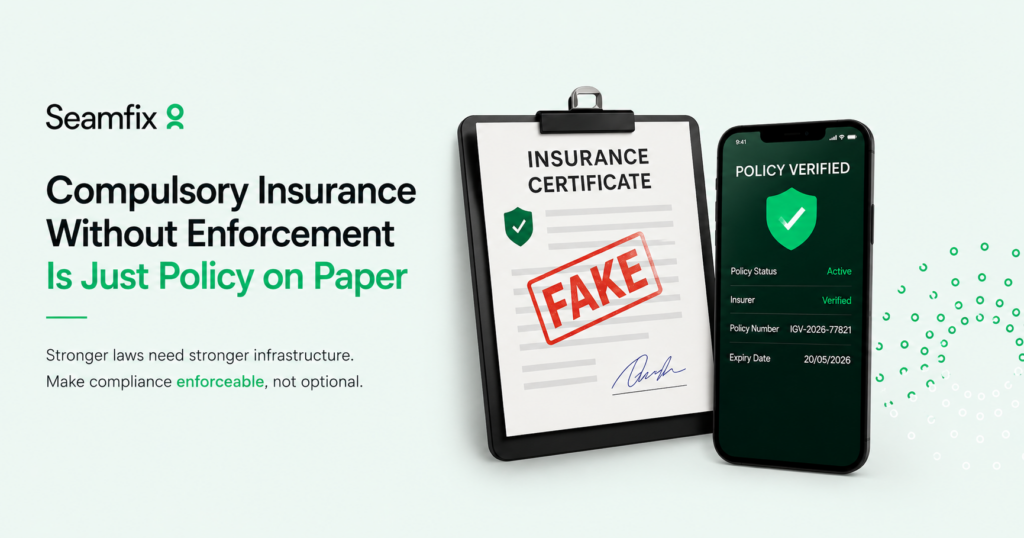
Fake insurance certificates remain common. Manual verification processes create loopholes. Enforcement agencies struggle to confirm whether coverage is genuine in real time. Compliance becomes inconsistent, and public confidence suffers.
The problem is not the absence of policy.
It is the absence of infrastructure that makes policy enforceable.
This distinction matters because compulsory insurance is not merely a regulatory requirement. It is a public trust mechanism. These policies exist to protect citizens, businesses, and institutions from financial risk. When enforcement breaks down, the consequence is not simply regulatory inefficiency, it is systemic failure.
In markets where verification remains fragmented, compulsory insurance becomes advisory rather than enforceable.
Why Compulsory Insurance Enforcement Breaks Down
The assumption behind compulsory insurance is simple: if coverage is mandatory, compliance should follow.
In practice, enforcement is only as effective as the infrastructure supporting it.
Verification Is Often Document-Based, Not System-Based
In many environments, proving insurance coverage still depends on presenting a document.
That document may be printed, manually issued, altered, expired, or entirely fraudulent.
This creates an obvious weakness.
Where enforcement relies on visual inspection rather than instant digital verification, fake certificates become easy to circulate. Enforcement officers are forced to trust paperwork rather than authoritative system validation.
The result is predictable: compliance becomes inconsistent, and fraud thrives in the gaps.
A compulsory insurance regime cannot function effectively if verification is easier to bypass than to enforce.
Enforcement Agencies Lack Real-Time Access
Compulsory insurance enforcement often involves actors beyond the insurance regulator itself.
Road safety agencies, police authorities, construction regulators, and other compliance bodies may all play enforcement roles depending on the insurance class.
But these stakeholders frequently lack access to real-time policy intelligence.
This means critical questions become difficult to answer instantly:
- Is this policy active?
- Was it genuinely issued?
- Has it expired?
- Does this certificate match the actual insured party?
Without connected verification infrastructure, enforcement becomes slow, manual, and vulnerable to abuse.
Market Fragmentation Makes Oversight Difficult
Even where insurers are compliant individually, ecosystem fragmentation creates enforcement blind spots.
Each insurer may maintain separate issuance systems, customer records, and reporting processes. Regulators may receive periodic submissions, but not continuous market-wide visibility.
This creates a structural oversight gap.
A regulator may know what has been reported, but not necessarily what is happening in real time across the ecosystem.
And without centralized visibility, enforcement becomes reactive rather than systemic.
The Real Cost of Weak Enforcement
The most obvious consequence is fraudulent compliance.
People appear insured when they are not.
But the deeper consequences are more significant.
Consumers lose trust in compulsory insurance when fake documentation appears widespread. Legitimate insurers are disadvantaged when non-compliant actors bypass requirements. Regulators face reputational pressure when laws exist but enforcement remains visibly weak.
More importantly, the public protection objective breaks down.
Compulsory insurance exists because certain risks should not be left unmanaged.
A driver without valid coverage creates downstream risk for accident victims. A construction project operating without proper insurance creates exposure for workers, contractors, and the public.
When enforcement fails, the cost is transferred elsewhere.
Weak enforcement is therefore not just an operational problem.
It is a governance problem.
What Effective Compulsory Insurance Enforcement Should Look Like
Modern enforcement requires a shift from document validation to infrastructure-based verification.
That begins with instant policy authentication.
Authorized enforcement actors should be able to verify policy authenticity in real time through a trusted digital source rather than relying on static documentation.
Second, compulsory insurance oversight must be centralized enough to provide ecosystem visibility.
Regulators should be able to see active policy issuance trends, monitor compliance levels, and identify anomalies without waiting for fragmented reporting cycles.
Third, identity integrity must be built into the process.
A policy is only meaningful if it is tied to a verifiable individual or corporate entity. Weak identity controls undermine the integrity of compulsory coverage from the outset.
Finally, interoperability is critical.
Insurers should not be forced to abandon operational systems. Effective enforcement infrastructure should sit above existing workflows, connecting ecosystem participants through shared verification standards.
How InsureGov Solves This
This is exactly the infrastructure gap InsureGov addresses.
InsureGov provides a shared insurance identity and compliance infrastructure that makes compulsory insurance enforcement operationally practical.
Rather than relying on disconnected insurer records and document-based verification, enforcement becomes system-based.
Policies can be tied to verified individuals or corporate entities using authoritative identity validation. Regulators gain stronger visibility into ecosystem activity, while enforcement stakeholders can verify coverage more confidently.
This creates a significant shift.
Compulsory insurance moves from a paper requirement to an enforceable digital compliance framework.
And because InsureGov integrates with existing insurer systems rather than replacing them, adoption becomes significantly more realistic at market scale.
The Bigger Picture
Compulsory insurance only delivers public value when compliance can be trusted.
Strong regulation is necessary, but regulation alone is not enough.
Without verification infrastructure, enforcement agencies are left inspecting documents instead of validating truth. Regulators receive delayed snapshots instead of real-time visibility. Citizens are expected to trust a system that remains vulnerable to circumvention.
That is not sustainable.
The future of compulsory insurance enforcement will belong to markets that make compliance digitally enforceable,not merely legally required.
Get started
If compulsory insurance in your market still depends on fragmented verification, manual checks, and delayed oversight, the infrastructure gap is already clear.
Speak with us to explore how InsureGov can help build a more connected and resilient insurance market.