Disaster Recovery Isn’t a Backup Strategy—Here’s Why
By Seamfix Engineering 4 min read
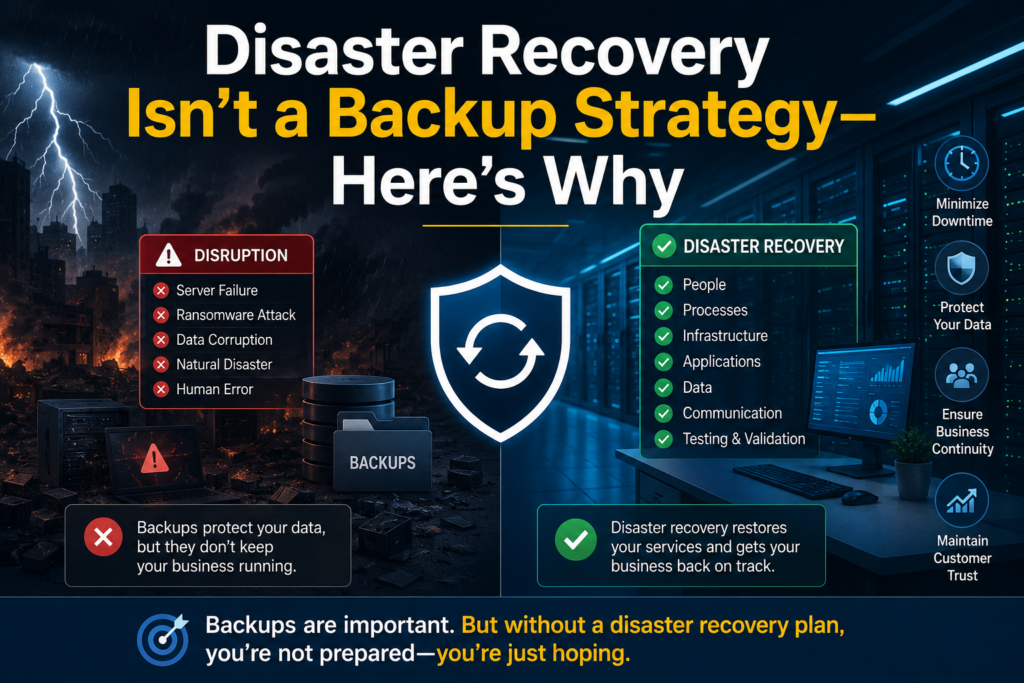
In today’s digital world, data is one of an organization’s most valuable assets. Every transaction, customer interaction, and business decision depends on reliable access to data. While many organizations invest heavily in backup solutions, there is still a common misconception that having backups alone is enough to recover from a disaster.
It isn’t.
Backups are an essential part of data protection, but they represent only one component of a comprehensive disaster recovery (DR) strategy. Organizations that confuse backups with disaster recovery often discover the difference only when a major outage occurs—and by then, the cost can be significant.
Understanding the Difference
Although the terms are often used interchangeably, backups and disaster recovery serve different purposes.
Backup focuses on preserving copies of data so it can be restored if information is accidentally deleted, corrupted, or lost.
Disaster Recovery is a broader strategy designed to restore entire business services after a disruptive event. It includes people, processes, infrastructure, applications, databases, networking, and communication plans that enable an organization to resume operations within acceptable timeframes.
Think of it this way:
- A backup is your insurance policy for data.
- Disaster recovery is your plan for keeping the business running.
Having one without the other leaves critical gaps.
When Backups Alone Are Not Enough
Imagine your production database server suddenly fails because of hardware failure, ransomware, or a regional power outage.
If your only recovery plan is to restore data from backups, several questions immediately arise:
- Where will the database be restored?
- How long will the restoration take?
- Are the application servers available?
- Is the backup valid and recoverable?
- Have recovery procedures ever been tested?
- How much data will be lost?
- Who coordinates the recovery effort?
Without documented answers, backups provide limited value during a real crisis.
Common Disaster Scenarios
Organizations should prepare for events beyond accidental data deletion, including:
- Hardware failures
- Storage corruption
- Human error
- Cyberattacks and ransomware
- Cloud service disruptions
- Network failures
- Data center outages
- Natural disasters
- Software defects following deployments
Each scenario requires more than simply restoring backup files.
The Hidden Risk: Untested Backups
One of the biggest mistakes organizations make is assuming backups will always work.
Successful backups do not guarantee successful restores.
Backups may fail because of:
- Corrupted backup files
- Missing transaction logs
- Incomplete backup schedules
- Encryption key issues
- Storage failures
- Version incompatibilities
- Misconfigured backup jobs
A backup that has never been tested should never be considered reliable.
Regular restoration testing should be part of every organization’s operational routine.
The Pillars of an Effective Disaster Recovery Strategy
A mature disaster recovery strategy includes much more than backup software.
1. Clearly Defined Recovery Objectives
Every organization should define:
- Recovery Time Objective (RTO): How quickly systems must be restored.
- Recovery Point Objective (RPO): The maximum amount of acceptable data loss.
These objectives guide the design of the recovery architecture and influence investment decisions.
2. High Availability
Where possible, critical databases should be deployed with high-availability mechanisms such as:
- Database replication
- Automatic failover
- Load balancing
- Redundant infrastructure
These reduce downtime and improve service continuity.
3. Regular Backup Verification
Backups should be:
- Monitored
- Verified
- Restored periodically
- Stored securely
- Protected from unauthorized access
An unverified backup cannot be assumed to be usable.
4. Documented Recovery Procedures
Recovery should never depend solely on institutional knowledge.
Well-documented runbooks should describe:
- Recovery steps
- System dependencies
- Contact lists
- Escalation procedures
- Validation steps after restoration
During an incident, clear documentation saves valuable time.
5. Routine Disaster Recovery Drills
Organizations regularly conduct fire drills without expecting a fire.
The same principle applies to disaster recovery.
Periodic recovery exercises help teams:
- Validate procedures
- Identify configuration issues
- Measure recovery times
- Improve coordination
- Build confidence before a real emergency
Testing reveals weaknesses before they become costly failures.
The Role of Database Administrators
Database administrators play a central role in disaster recovery readiness.
Their responsibilities extend beyond backups and include:
- Designing resilient database architectures
- Implementing replication strategies
- Monitoring backup health
- Validating recovery procedures
- Optimizing restoration performance
- Collaborating with infrastructure and security teams
- Continuously reviewing disaster recovery plans
A proactive DBA helps ensure that systems remain available even under challenging conditions.
Disaster Recovery Is a Business Strategy
Disaster recovery is often viewed as a technical responsibility, but its impact reaches every part of the business.
Extended downtime can lead to:
- Lost revenue
- Reduced productivity
- Regulatory compliance issues
- Customer dissatisfaction
- Reputational damage
- Increased operational costs
Investing in disaster recovery is ultimately an investment in business resilience.
Key Takeaways
Backups are essential, but they are not synonymous with disaster recovery.
Organizations should ensure they:
- Maintain reliable backup processes.
- Regularly test backup restoration.
- Define clear RTO and RPO objectives.
- Implement high-availability solutions where appropriate.
- Document and rehearse disaster recovery procedures.
- Continuously review and improve recovery plans.
When disruption occurs, success is determined not by whether backups exist, but by how quickly and confidently the organization can restore critical services.
Final Thoughts
The question is no longer “Do we have backups?”
The better question is:
“If our primary environment became unavailable today, how quickly could we restore our services and continue serving our customers?”
The answer to that question defines the strength of your disaster recovery strategy.
A resilient organization doesn’t simply back up its data—it prepares to recover its business.