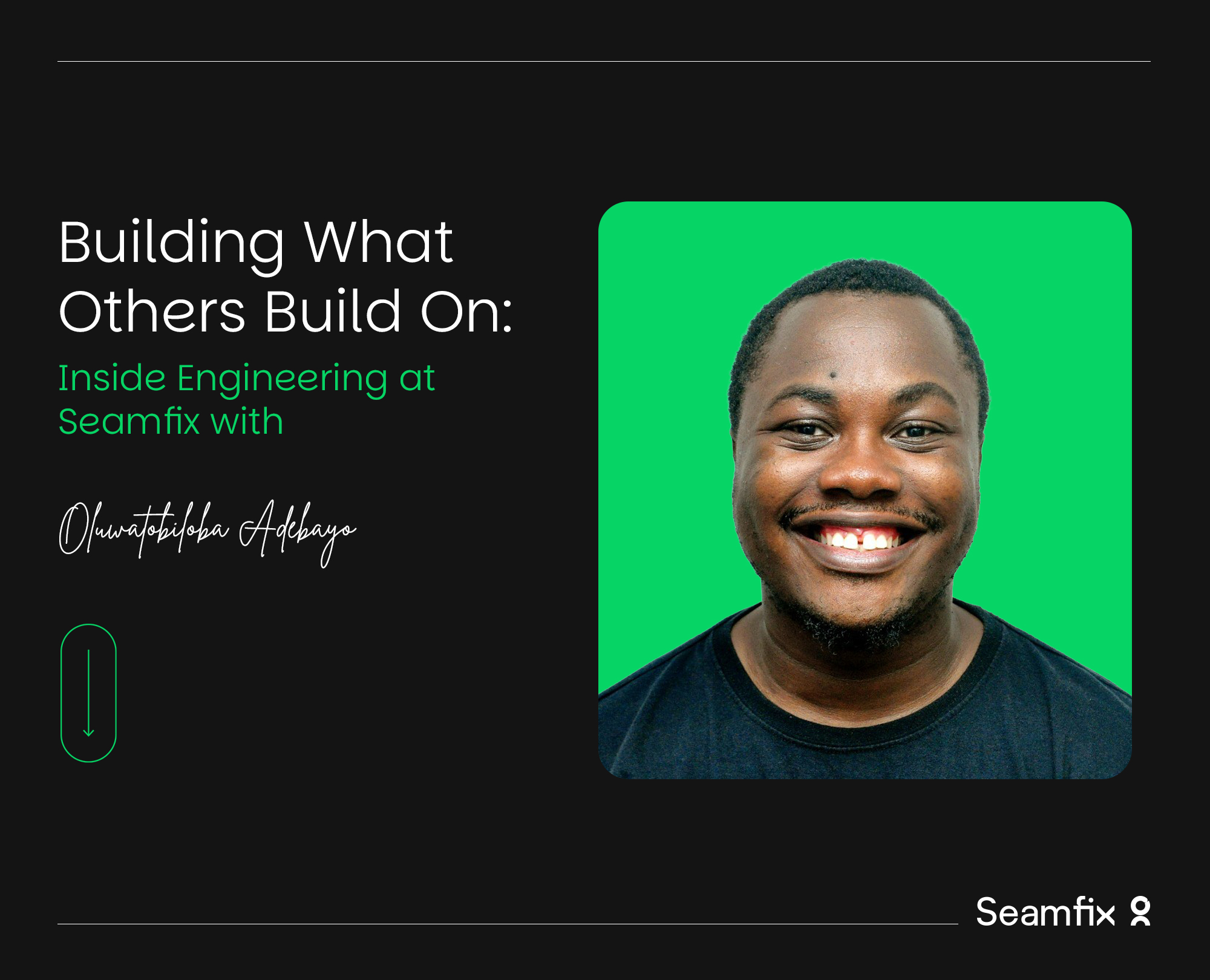
Sometimes, all it takes is a moment of curiosity to change everything.
For Oluwatobiloba Adebayo, that moment came unexpectedly, not from a classroom or a career plan, but from watching a friend write code instead of playing games on a PS4. What started as curiosity quickly turned into a calling, setting him on a path into engineering.
Today, as a Principal Engineer at Seamfix, Oluwatobiloba works at the foundation of our systems, designing scalable architectures, enabling teams, and solving complex problems that power multiple products behind the scenes.
In this spotlight, he shares his journey, what it means to build at scale, and why engineering at Seamfix is as much about growth and collaboration as it is about code. Let’s dive in!
How did you get into engineering, and what brought you to Seamfix?
Funny enough, it started with a PS4. I had gone to a friend’s place to play games back in 2017, but instead I found him writing code. I got curious, asked questions, and that moment pulled me in. I decided to explore it myself, and from there, it just stuck, the rest is history.
As for Seamfix, I joined in 2024 through a recommendation from a mentor of mine. I still remember what he told me: “You will work hard, but you’ll learn a lot.” That turned out to be very accurate, and it’s been a rewarding experience so far.
How would you describe your journey so far in your own words?
Like I said, it’s been a truly rewarding experience. In many ways, it feels like I was meant to be here. I’ve learned a lot, had the opportunity to speak in rooms I might not have found myself in otherwise, and been part of some really meaningful conversations.
Along the way, I’ve also had the chance to do some impactful work and mentor some amazing people, which has made the journey even more fulfilling.
What does a typical day or week look like for you as an engineer?
As a Principal Engineer, my days tend to be a bit more intense and focused on high-level work. I spend a good amount of time designing abstractions and building solutions that other teams can adopt with minimal customization.
Beyond that, I’m often involved in architectural design discussions, reviewing systems, and making decisions that shape the direction of our platforms. I also handle production issues when they arise and spend time in meetings aligning with different teams to ensure we’re building efficiently and consistently.
What’s one recent project you worked on that you’re proud of, and why?
I’m proud of a lot of the work I’ve been part of here because it’s been consistently challenging and impactful. But if I had to single one out, it would be around our productization strategy.
I worked on creating a base project, essentially a reusable, extensible foundation, that other product teams can inherit from. The goal was to standardize core patterns and reduce duplication, while allowing teams to plug in their specific business logic with minimal friction.
From an engineering perspective, it involved designing scalable abstractions, enforcing consistency across services, and enabling a more modular architecture. I’m particularly proud of it because it improves developer experience, speeds up delivery, and sets a solid foundation for how we build going forward.
How does your work impact users or the business in a real way?
My work mostly sits at the foundation level, so its impact is felt across multiple products and teams. By building reusable abstractions and standardizing how we develop services, I help reduce duplication, improve consistency, and speed up delivery across the board.
For the business, this means we can ship faster, scale more efficiently, and maintain higher quality systems. For users, it translates to more reliable products, better performance, and a smoother overall experience.
I’m also involved in handling production issues and architectural decisions, which directly affect system stability and uptime. So while my work may not always be user-facing, it plays a critical role in ensuring that everything works as expected when it matters most.
How would you describe collaboration within the engineering team at Seamfix?
Honestly, it’s been superb. Like any team, there are a few occasional bumps, but nothing out of the ordinary. Overall, everyone is very willing to support each other and collaborate.
One thing I really value is the openness, I’ve had multiple conversations with the CTO when I didn’t fully understand certain decisions, and I’ve never felt uncomfortable asking questions, even when they might seem basic. That kind of environment makes a big difference.
It creates a culture where people can learn, contribute, and grow without hesitation, and that’s been very positive for me.
What’s something about the engineering culture here that stands out to you?
One thing that really stands out is the openness and willingness to support each other. There’s a strong culture of collaboration where people are encouraged to ask questions, challenge ideas, and have honest conversations without feeling judged.
I’ve personally experienced this in how approachable leadership is—I can have direct conversations with the CTO to better understand decisions, and there’s always room for dialogue. That kind of psychological safety makes it easier to learn, contribute meaningfully, and grow.
It’s a culture that values both delivery and development, and that balance is something I find very important.
How has your role or skill set evolved since joining Seamfix?
Since joining Seamfix, my role has changed a lot. I started more focused on building, but now I’m thinking more at a system level, how things fit together, how other teams can use what we build, and how to reduce repeated effort across the board.
I’ve gotten deeper into architecture and making decisions that affect multiple teams, not just one service. I also deal more with production issues now, so I’ve had to become more comfortable making quick, high-impact decisions when it matters.
I’ve also grown in mentoring and guiding other engineers, and being part of more strategic conversations. It’s less about just writing code now, and more about enabling others and making sure we’re building things the right way.
What’s one major thing you’ve learned or improved while working here?
One major thing I’ve really improved on is thinking beyond just solving the immediate problem. I’ve learned to step back and ask, “How does this scale? Who else will need this? How can we avoid solving this same problem multiple times?”
Working here has pushed me to think more in terms of systems and long-term impact, not just quick fixes. It’s changed how I approach building solutions entirely.
What keeps you motivated in your work as an engineer here?
Honestly, it’s a mix of the challenges and the impact. The kind of work I get to do here isn’t just about building features, it’s about solving real system-level problems and making things better for multiple teams at once.
I also enjoy the learning curve. There’s always something new to figure out, whether it’s architecture decisions, production issues, or just better ways of doing things. That constant push keeps me sharp.
And then the environment matters a lot too. Being able to collaborate openly, ask questions freely, and actually see ideas turn into real systems that people use, that’s what keeps me going.
What do you enjoy most about working at Seamfix?
What I enjoy most is the combination of the work itself and the environment. The problems are challenging in a good way, they push me to think beyond just code and focus more on systems, scale, and long-term impact.
I also really value the people and the openness in the team. You can ask questions, challenge ideas, and have proper conversations without feeling out of place. That makes it easier to learn and actually enjoy the work while doing it.
What would you say to someone considering joining the engineering team?
I’d say come in ready to work and ready to learn. The work here can be challenging, especially if you’re dealing with platform-level problems or thinking about scale and architecture.
But at the same time, it’s a place where you’ll grow fast. You’re exposed to real production systems, you get to work with people who are willing to help, and you’re encouraged to ask questions and figure things out properly.
So if you’re looking for a place that will stretch you technically and also support your growth, it’s a good fit.
“Working at Seamfix feels like…”
working on real, challenging problems that force you to grow quickly, while being surrounded by people who are willing to help you figure things out and get better at what you do.